

By: Hillel Fuld
As time goes by and I spend more time on Twitter, two things seem to be happening. On the one hand, I am finding that the number of great people and amazing relationships I build on a daily basis, is only growing. As more people join Twitter and the micro blogging service hits the mainstream, I am regularly meeting new folks that are not necessarily part of the “early adopter” community, and that is great. On the flip side, more and more people are talking about Twitter and its explosive potential, which results directly in people trying to manipulate the system.
I referenced these types in my last post “The Down Sides of Social Media! Yes, There are Some…” but I find that I am seeing these people more often now, and they seem to be learning new tricks all the time. It is important to not let these people give the rest of us a bad name, the same way we should not give cheap and spammy marketers the ability to ruin the reputation of true marketing professionals. I thought I would give a short list of things you should look out for before connecting with these so-called social media fakers (who call themselves social media experts 99% of the time, interestingly enough).
Also, it is important to understand why you do not want to connect with these people, and the reason is association. You do not want to be associated with such people who will ultimately pollute your social graph, which is all we have when it comes to the Web. Right now we are building our networks on the various social sites, but these friends/followers/fans will eventually say a lot about a person, especially in light of Google focusing on social and integrating social in their search results. So, be careful who you connect with on the social Web.
The following is a short list of “tricks” I have seen performed by many “social media fakers” in order to increase their following and build themselves an online reputation with no real justification:
-Reply to Elite Only: Wow, even writing this post and specifically this point is making my blood boil. Some people had Twitter sold to them by being told that on Twitter, you can talk to your favorite celebrities. While this is true, and you can definitely connect with people you never thought possible before social media, that is far from the point. However, I am not going to focus on the people that sit on Twitter ten hours a day and write to Ashton Kutcher, Alyssa Milano, and Charlie Sheen, those people are just plain stupid.
I am more interested in talking about the people who cover it up much better. These people will only reply to someone with over 1,000 followers (or choose any other arbitrary number). Here is a good way to check if you are falling into this trap. Check your Twitter stream at any given moment and make sure you have replies to people with a few followers as well. Let me emphasize, there is nothing wrong with connecting with people who have lots of followers, but if their followers are the reason you are connecting, you are doing something very wrong.

-99% Broadcast, 1% engage: While many people talk about numbers on social media, it is pretty clear now, that a follower count is close to irrelevant. However, a number I am VERY proud of on Twitter is the percentage of all my tweets that are replies. Last time I checked, over 85% of all my tweets are replies. That means I only “broadcast” my content 15% of the time and engage 85% of the time. Now, that might be a little overboard, but it is definitely important to engage over 50% of the time you spend on Twitter. If someone new follows me and there are no replies in their ten most recent tweets, that person goes straight to my Trash folder in Gmail.
Also, I have to emphasize that the backlash I get to all my Twitter posts about there being no right and wrong way to tweet is spot on. There are no rules except one, don’t be a spammer. If you are only broadcasting and not replying to people, whether or not you are selling Viagra or thousands of instant followers, sorry to break it to you, but you are a spammer. Not the type to sit behind bars, but the type that deserves to be blocked on Twitter.
-Keywords: This is old school spamming, but it seems the Web spammers got bored of blog comments and dirty SEO, so they ported it over to Twitter. By using keywords from the trending topics on Twitter, these people believe they will be discovered and followed via Twitter search. I know that this often works, since I have seen many people who are clearly spammers, not following anyone, but with thousands of followers. Boggles my mind every time. The way these social media fakers do this is by including words like “iPhone” or “Justin Bieber” in their tweets and profiles. While this might work in the short term, it won’t be long before these people are blocked and banned from Twitter.

-Sell Hot Air: This is for the more advanced social media faker. These people apparently believe the saying “Fake it till you make it” (thanks Zipporah), the problem is, in most cases, these people are way too transparent. Unfortunately, you will not be able to recognize this person as a social media faker until you put them to the test. Once they say the sentence “There is no way to measure ROI on Twitter”, you know you caught a big fish.
These people call themselves experts in their field, have close to no knowledge or experience in the space in which they are operating, and when it comes to delivering the goods, they are nowhere to be found. I have also found these people to send tweets to real experts in their field so as to create an illusion that they are connected. One test you can use to find such a person is by seeing who they reply to, then checking out the other person’s timeline to see if they replied. If a person is continuously writing to industry experts and getting no responses, that is a good sign that something is fishy.
-Follow the Crowd: Here is a common technique used by social media fakers and one that you can see almost immediately. They follow a lot more people than follow them. Why do they do this? Well, they are hoping that by following thousands of people, at least half will follow them back automatically, then they can use a tool to unfollow those that did not. It is a smart technique, but during that interval in which they are following thousands and have only hundreds of followers, these people are announcing to the world that they are indeed spammers and should not be followed.
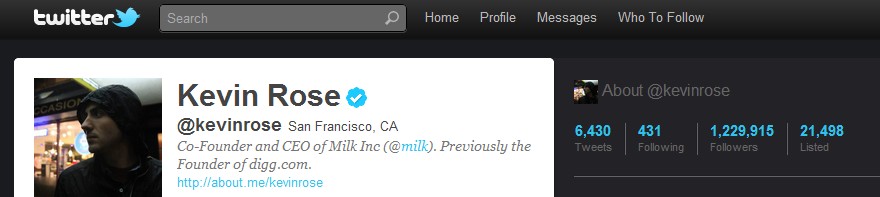
By the way, the opposite is true as well. If you see someone who has thousands of followers and follows close to none, and his name is not Kevin Rose, you know there is something wrong. Generally speaking, I do not believe follower count matters, but follower count ratio definitely does.
Ask for follows: There are two ways to do this. Some ask for follows straight out, which indicates right away that this person is a spammer. However, I want to focus on the smarter social media fakers who do this in a much sneakier way. “I need to DM you something, can you hook me up with a follow?” or “Awesome to connect, would love to DM something over” are some examples I have seen of people asking you to follow them. Don’t get me wrong, I have on occasion asked someone to follow so I can DM them something, but I am talking once or twice in extreme situations. These people make it a strategy.
The bottom line is, if you see someone who is asking for follows, in a straight forward or sneaky way, you know that person is obviously not offering enough value to generate a nice following organically, and has to reduce himself to asking for followers. That is not the type of person you want to follow or be associated with.
While writing this post, I turned to my followers with this question, and got some awesome answers. However, one of the important responses I got was the question “How do I define a faker as opposed to a real expert”? My answer is that if this person’s expertise exists in real life as well, as in they can deliver on the promises they make online, then go ahead, sell yourself on Twitter. If, however, this so-called expertise stays on Twitter and does not translate in any way to some sort of ROI, I would say it is time to look for a new profession.

Did I miss anything? What other tricks have you seen spammers pull on Twitter and social media? Please let me know in the comments or you can reach out to me on Twitter. I am @hilzfuld there, and chances are, I will reply.
Nice post, Hillel.
You didn’t mention how people use fake Twitter lists and then create these elaborate list swapping relationships to boost up their list count. I think I’ve made it onto a few of these padder listings, but I never create my own.
Thanks Said, forgot to DM the article to you like you asked. Happy you found it anyway 🙂
Loved this post, ticked all the right boxes for me, i was thinking of writing something similar on my own blog but you do it far more eloquently than I.
Well worth a RT in my opinion…
Seems so many out there allegedly have ‘ the answer’ which technically means that they ‘don’t’ but whatever it is they do have you will have to pay for. And then it’s just another form of Pyramid selling I guess?
All in all I love Twitter and the community is always helpful and on the whole positive, but sometimes, sometimes it’s just too much of a trial.
Thanks
Great read
Conal
Fantastic Post, Hillel!
Also- if you see a twitter feed that you aren’t following, is sending a link @you, it pays to check out if they have virtually no followers and are just using spam software to tweet @ people with a link.
and I have noticed that it’s not the same link being sent to everyone… each link seems unique!
i take the time to block and report these accounts. While I don’t know if it helps in the long run, somehow it makes be feel a bit better…. 🙂
thanks guys, glad you enjoyed my rant 🙂
Took me a lot longer than 10 secs to read, but nice post and well worth it.
Thanks Mark, each one of the points can help you spot the faker in ten seconds. Never said the post would take ten seconds to read 🙂
Great post!
Those so called “Social Media Experts” are the ones that make the job of Social Media Strategists just that just more of a challenge for people to take serious.
Social Media is meant to be social not automated or spammy.
My opinion.
Nice article. Twitter seems to be evolving, like all social media, in response to the way users use the platform. I had a great discussion with my students the other day about how they use Twitter and posted something based on my findings here: http://ow.ly/4Fd4u (please don’t think this is too spammy – LOL).
It seems they’re mainly using Twitter as a glorified text messaging system and to voice complaints to companies. They’re totally uninterested in following or being followed or the number — they just want to talk to their friends on Twitter. They also look at Tweets related to trending topics – mostly entertainment related.
Great post – I don’t which irks me more someone I don’t know DM’ing me wanting me to RT something for them, or someone I don’t know @naming me begging me to follow them and asking me to RT it.
I don’t mind doing favors for my friends… but get to know me first – GEEZ!
I think there is still a middle category of Twitter person that is much more pernicious and interesting to think about: the self professed social media consultant/guru that is actually making money or out there giving advice. these are people that aren’t necessarily gaming the system. Yet they are controversial for giving out simplified or misguided advice. They are also late comers onto the scene, annoying in their assertiveness, the list goes on and on. I’d say its definitely a middle category of social media intelligence that i try my best to not be a part of.
Enjoyed the read. I know I can get an uncomfortable disparity between the number I’m following and number of followers, but that is because I’m in seeker mode right now. I do read each bio, and review timelines, before following…picking those for which I have a genuine common interest. I’m trying to grow a tribe. I know I do have some obvious spammers that have made it to my follower list, but I try to be courteous and give them a shot before unfollowing.
You are AWESOME!!!!!
I disagree.
People use twitter for different things. Lately I’ve been reading insane amounts and I like to share the most interesting articles to Twitter & LinkedIn. As such, most of my stream are article posts, not Replies. My engagement level is lower than it used to be. Especially since half my conversations go on via DM. What about people who curate content? Does that make me a “faker”?
Also, I don’t follow back everyone who follows me. I only follow people who I feel give good content. Sometimes (rarely) that’s someone who only has links in their stream – but they are good links (as I noted above – I’m quite the reader).
IMHO the fakers are people who create multiple fake accounts and have conversations amongst them. I don’t really get this tactic, but people do it so apparently it works. I also don’t get spam. But as it doesn’t seem to die the horrible death I keep wishing it I have to assume it works as well.
Give good content. Be friendly. Be nice. Avoid douches. And if you don’t like someone, don’t follow them. That’s real social media today.
@shiraabel
Great information for those of us still new to Twitter! Thanks for sharing 😀
Hey Hillel. So your post is interesting, and I’m clearly no twitter expert, but from what I understand I only agree with one point. IMO anyone can follow as many people as they want, engage as much or as little as they want, and they’re still using twitter how they are comfortable using it.
IMO the only thing that would define a spammer is someone Who is actually a scam artist, trying to sell goods/ services fraudulently. If someone is legitimately able to sell something, let them tweet a hundred times a day for all I care, promoting their services, if you don’t like it don’t follow. If enough people unfollow, he’ll get the point it’s not working. However If he makes even one sale from it, good for him. Again if you don’t like it, don’t follow. I don’t think any one person or group of people have a monopoly on how to use twitter. Like a previous commenter said, twitter is used how people use it, and some might be there to build relationships (like you) some might t get instant news, but have conversations with no one (like me) and some might use it to drum up some business.
Again as far as I’m concerned the only faker on twitter is a faker in real life (like you said). If someones legit, let him have thousands of robots following him for all I care, he’ll see it’ll either work or it won’t.
Chag sameach!
Etana, thanks for reading and commenting. I think you might be missing the point… These people are not just tweeting most of the time, they are actually @ ing (replying) to me and others… If you want to understand more about the difference between a tweet and a reply on Twitter, see this post: https://www.technmarketing.com/web/everything-you-need-to-know-about-twitter-and-tweeting/
That it what I am referring to when I say spamming. Even if they are not replying to people, the point is that people who are just using social media for self promotion, are polluting the network. That is not what it was intended for, hence the word “social” in social media.
Also, the big difference between you and these people is that you state straight out that you are not an expert, these people, who generally have less knowledge than you about this, call themselves experts.
In addition, I think there might be some confusion here between spammers and scammers, it is not the same thing… You do not need to be tricking someone in order to annoy them on social media.
In any case, I think if you hung out on Twitter more, you would see what I am talking about in this post. Also, the 250 retweets this post got shows that others experience the same frustrations.
This tweet that someone wrote me about the post pretty much sums it up: http://twitter.com/rainbowclaire/statuses/62076153883660288
If Etana misunderstood your point then so did I, and Shira too – maybe it’s because you said “If you are only broadcasting and not replying to people… sorry to break it to you, but you are a spammer.” This sounded like a very strong accusation and it sounded to me like I’m included in that definition. I am relatively new to Twitter, I’ve been gradually finding interesting accounts to follow but I’m mainly there to tweet; when I have on the odd occasion replied to someone’s tweet, I have usually not got any response, which kind of makes me feel like it’s pointless to reply to those who don’t know me and have a large following. So if you look at my timeline you won’t see many replies. But I ain’t no spammer.
The same thing is happening on face book everybody claim to be an expert I own a reputable carpet cleaning company I receive 2 phone calls a day from seo companies wanting thousands of dollars to market your business for you. and they follow you and send messages .
This is gold! I love it how you’re not afraid to take a stand and pop some bubbles when necessary; this takes guts 😉
It’s funny. I’ve experienced several of these, though having it organized in this fashion is very helpful. What is interesting is the spamming to get followers post. I’ve seen the “be my 900th follower” and “I only need 3 more to reach 1000” – but just yesterday was the first time someone wrote to me and asked me to follow them so they could DM me something. And even though they didn’t – I didn’t really make the connection until I saw what you wrote, went back and looked at his tweeting history. Good catch, Hillel – as always!
I’m just getting in to twitter and after reading your post I realize now why people are following me without me actually putting a lot out there. They’re just looking for a recipricol follow. I haven’t done much with twitter until I can determine what I should be doing with it but I will keep all these things in mind as I learn how to use it. Thanks for the insight. Makes me feel like such a noob.
I’ll add that a good indicator the person is a spammer, is if it has as picture a really good looking girl. :o)