
By: Hillel Fuld
I have been on Twitter for a year and a half now, and contrary to what people seem to think, the “phase” does not look like it is passing any time soon. Twitter still manages to amaze me with its unprecedented effectiveness as a networking tool and information source. I am constantly meeting interesting people I would never have crossed paths with had it not been for Twitter and I also spend a lot less time reading RSS feeds and news sites since all that information comes from my Twitter stream.

So, the good things about Twitter have not changed, but unfortunately, the bad things have not either. There are still things I see being done daily in the Twittersphere that just annoy me and make me unfollow some folks. Some of these things seem like common sense to me, but I guess some people still need reminding. The following are five things people have to stop doing on Twitter:
- Auto DMing: I have spoken about this already numerous times, and everyone seems to hate auto DMs, yet there are still people, and a lot of them, who send auto DMs when they are followed. It really does not matter what is in the DM, but if you have your account configured to send an auto DM every time someone follows you, you are making a mistake that is sure to cost you in followers. One example that I find 50% of all people I follow do, is this truetwit validation thing. It is meant to block out spammers and requests from anyone who follows you to validate their account. In theory, a good idea, but annoying as heck in practice. I for one, unfollow anyone who sends me this DM, as well as any other auto DM. It is not about automating the process, it is about communicating and creating online dialog, an authentic dialog, not an automatic one. OK, enough about that, just got a truetwit DM, gotta go unfollow…

- Spamming: C’mon people, it is 2010, you should know by now that spam does not work, not to mention that it is just wrong. Somehow people think it is OK to find people with a lot of followers, and ask them to vote for them or support them in some cause. Not only does that not work since the Web is filled with malicious links, and most people are hesitant to click links sent by someone they do not know, but when I get such a message, I report that person to Twitter spam. So, if you need someone to click your link or do something to help your cause, follow them, communicate with them, build a relationship, then ask them for a favor. This might take a little longer than sending one message, but it is way more effective. It’s actually very simple, act on Twitter like you would act in real life, just be real and yourself, and you will be surprised at how quickly you see results.
- Not Hitting Reply: OK, this one is a little more complicated. On Twitter, when someone replies to you, you can click “In Reply To” right under that person’s reply to see exactly what question of yours they are answering. You can use this feature to put tweets in context, it is kinda like threaded conversations. However, this only works if the person hits Reply. If they just manually type out your name, or copy and paste it, and then go ahead and answer you, you will have no way of knowing what question they are answering. Every day, at least five times, I get a tweet that says something like “yes” or “absolutely” and there is no “In Reply To” under the tweet since the person did not hit Reply. So, when you are replying to someone on Twitter, make sure to hit the Reply button, that’s what it’s there for.

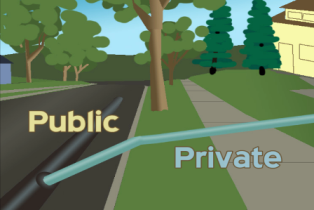
- Putting it Out There: There are differing opinions as to what DMs are for as opposed to replies. Whatever the case may be, it is important to note that tweets and replies are public, they are cached by Google and will appear in search results. If you are responding to someone and sharing information you do not want to be public, DM them. I recently asked someone for feedback on a blog post I was about to publish, I DMed them the preview URL and for some odd reason, they replied to me, publicly, with all their feedback. Why? Is that not what DMs are for? The bottom line is, some people hate DMs, and others use them all the time, whatever you decide, think about it before sending it and ask yourself “is this something I, or the person I am sending it to, want to be in the public eye, or should I perhaps be sending it privately?”
- Repeating Themselves: This is also not a clear cut issue, and many huge Twitter personalities like Guy Kawasaki, repeat tweets numerous times throughout the day. This is effective to get more eyeballs on the link, and it is needed for the different time zones. However, putting repetitive tweets aside for one second, people who tweet the same exact format in every single tweet are wasting theirs and my time. Let me give you an example. Have you seen those people whose Twitter stream consists of hundreds of tweets starting with the words: “New Blog Post:” I never ever click on a link like that. In fact, when I started out on Twitter, and would get an email notifying me that someone new is following me, I would look at the person’s profile, their picture, and even their follower count. As of a few months ago, I ignore all that, and look at the person’s last five tweets. If there is a reply in there, it is an almost definite follow back, if they all start with the same words, I make use of the nice Delete button. At the end of the day, people like to follow other people, and not machines. If you a person and not a Twitter bot or software, make sure to show that in your tweets, show some personality, some variety, and make sure each tweet is somewhat unique.



These are five of many things that are strangely still very common practices in the Twittersphere. The bottom line is, with tools like Twitter and others, there is no immediate and magic solution to building an effective network. It takes times and effort, but after you spend the time, the results Twitter will produce in terms of traffic, networking, and even promoting your product are unprecedented and unparalleled.
Agreed upon those – points and sadly many people do that. Replying to tweets from others is a major booster to your followers to as it indicates that you are a human.
I have seen a boost in my following primarily because I have increased the frequency to reply to people and stay connected.
Thanks for the post – useful tips for anyone who thinks Twitter hates him/her
Here’s #6: embedding links in an Ow.ly toolbar or similar.
Thanks for these, Auto DMs drive me nuts. I do repeat tweets throughout the day but I always write them fresh and try to put a different spin on it and I never repeat a tweet for a blog post with less than 2 hours, usually more like 3 or 4.
And it’s exactly as you say, I’m trying to hit different time zones. I’ve never used an auto program like tweet later.
Thanks for the list 🙂
Lisa
Agreed on most points except one.
The reason people spam links is because it DOES work. Twitter people are very likely to click marketing links in context that are interesting to them.
Next time someone messages you to send a link turn it around on them… Tell them you will for $xxx dollars. That’ll get tif of them or it’ll boost your paypal account.
I know seriously you don’t want to hear this but realistically spam is profitable Twitter especially since unlike email and automated forum spam the cost and barrier to entry is zero.. Which makes any roi very good.
This is good. I wrote a similar list on my blog recently.
http://www.thomasrye.com/2010/03/get-un-followed-on-twitter/
It’s basically “How to lose friends on twitter, heh heh. There are a lot of bad practices that people are using on twitter though. Keep pushing better use!!
Agree. Although I’m not new to internet, I’m relatively new to twitter, but in my short time here I’ve had some requests from ‘followers’ who just try to sell something or ‘they’ come from porn sites. Spam is a big problem, not only here on twitter.
Maybe the problem is not to sell something or to generate traffic to your web site, the problem is how they do that.
…and ok ok I updated my twitter profile 😀
I agree with your list 100%. Very well stated. I analyze ever single person who follows me and 90% are either ‘Followed’ or ‘Blocked’, there are few that I don’t follow back or chose to block.
I just wrote a piece about a person who had followed me and I had reviewed their twitter page. They scored well in my analysis, but they started every tweet with “Please RT:” Despite having good ratios, and wonderful tweet content, I still felt they should be blocked.
How will people learn, if we don’t punish them for doing these things?
Very useful info! I am amazed how people ignore the fact that tweets are public info! It is key to DM on some issues and I have had people tweet their response to my DM also! The repetitive tweets are silly but seem to work!! I’m not one of them but I believe in quality not quantity!! Great blog!
Some of us use SMS to participate in Twitter and in those instances, there is no “reply” button. Other than that, I agree with the other points.
And my particular hate “Just getting on AA287 ot Phoenix” or “Off to bed” WTFC
Here is #7: typing out your tweets like you are talking
Actual tweet (not by a robot spammer) – “yh I rah clockd that mercy ain’t in it. Bt I ain’t suprised tbh « kos zsa zsa, fatboy and leon r propa characters nw!”
Where do you begin reading that?!
This article is so true and it’s really to not commit any of these Twitter “crimes.” The auto-DM is super annoying to me so I would really love it if people didn’t do that.
The AUTO DM is the worst invention next to the auto followers. I would rather follow real people that only babble through out the day. I don’t want your book of tips. I don’t want to click your link. And I don’t want your free online book. I know the moment I sign up, you are going to spam me with lessons 2-102 in 3 days!
I agree with these! They’re kinda annoying sometimes, but we gotta look at the other side of the picture too. I’m not sure everyone’s on the same Twitter train as we all are. Most people don’t even know what to do once they’ve had an account!
I know a few people who do manual replies as opposed to hitting the reply button. Others don’t know what a retweet is or how to use it properly. A lot of them actually believe RT stands for “Reply To” in fact! Some people don’t know how DMs even work either. And some are unaware that DMs can only be sent to people who follow you. If you don’t follow them back, they can’t reply privately.
Twitter is a very different social network compared to most others of our time, so it takes a little getting used to. It took me months before I really started to get into it. I had Twitter since June 2008, I didn’t start tweeting until around April or May 2009. And I wasn’t even used to it back then.
Nice post! agreed with David’s one too!
Very very useful post. Completely agree with you. But one thing I must admit that I did not not really care about is ‘hitting reply button’. I didn’t exactly know the difference between directly typing user’s name and using the button. Thanks to you. And I’ll do so from now on. 🙂
“C’mon people, it is 2010, you should know by now that spam does not work, not to mention that it is just wrong”
Not to mention that it’s illegal!
Wow, I just signed on for the first time in 24 hours only to find one tweet from Alyssa, which brought over 5,000 readers to this post, all these comments, and a LOT of nice replies on Twitter. Thanks so much for your feedback guys, and please please connect with me on Twitter, I am @Hilzfuld, would love to meet all you guys…
Hillel — You are a class act and I am so happy to have met you via Twitter. Thanks for the post. When people do not engage/ reply to @replys, do you unfollow? I find this very annoying.
Hillel – I always learn something new from your posts! Thank you. Today I learned that it’s possible to trace a reply to an original tweet by hitting the “in reply to” words. I never even noticed those words until above when you circled them. Thanks again.
agree with some of it but not all of you suggestions but everyone is entil;ed to there own thoughts though
You are like a Twitter God. Wisdom and good looks, just the complete package.
So even though you say it is inevitable and you laugh at me day after day, I still don’t actually have a Twitter account.
Having that said, this is a great post. Even though I don’t use Twitter and it is all still foreign to me, your points above are quite logical and seem to make sense.
Great post… but to balance out what your mother wrote, you are still ugly 😉
Thanks Benji, was getting a little too cocky 🙂 Ha, can always count on you to bring me down 🙂
You have Great Twitter information.. and I enjoy reading all your insight on the subject of Twitter. Very good tips here. I have even twitted out links to some of your blog posts … but I do believe you exercised your “auto DMing” rule on me, as I noticed at one point you followed me, but not anymore.. I try to send out a DM to followers thanking them for the follow. So you must have thought that this was an “Auto DM” to you or simply did not like that I did DM you … Well I assure you – it was not an “Auto DM”.
This blog post brought that to my attention otherwise I may not have even noticed.
Regardless I will continue following you, reading your blog thoughts and probably continue with my Thank you message to followers.
If you’re using something like TweetDeck, but aren’t really paying attention or using twitter. Shut it down. That encourages the irritating “twitter fail whale”.
Thanks for the post!
Can we add referring to oneself as a “Social Media Guru” or as technical because they use Twitter.
Great list! Would indeed love it if people would pay more attention to all this. Maybe we need a twitter-police and if you breach one of the above rules you end up in twitter-jail 😉